A map, and walking on it
Run it:
cargo run -p tutorial --bin step01_walkingSource:
step01_walking.rs
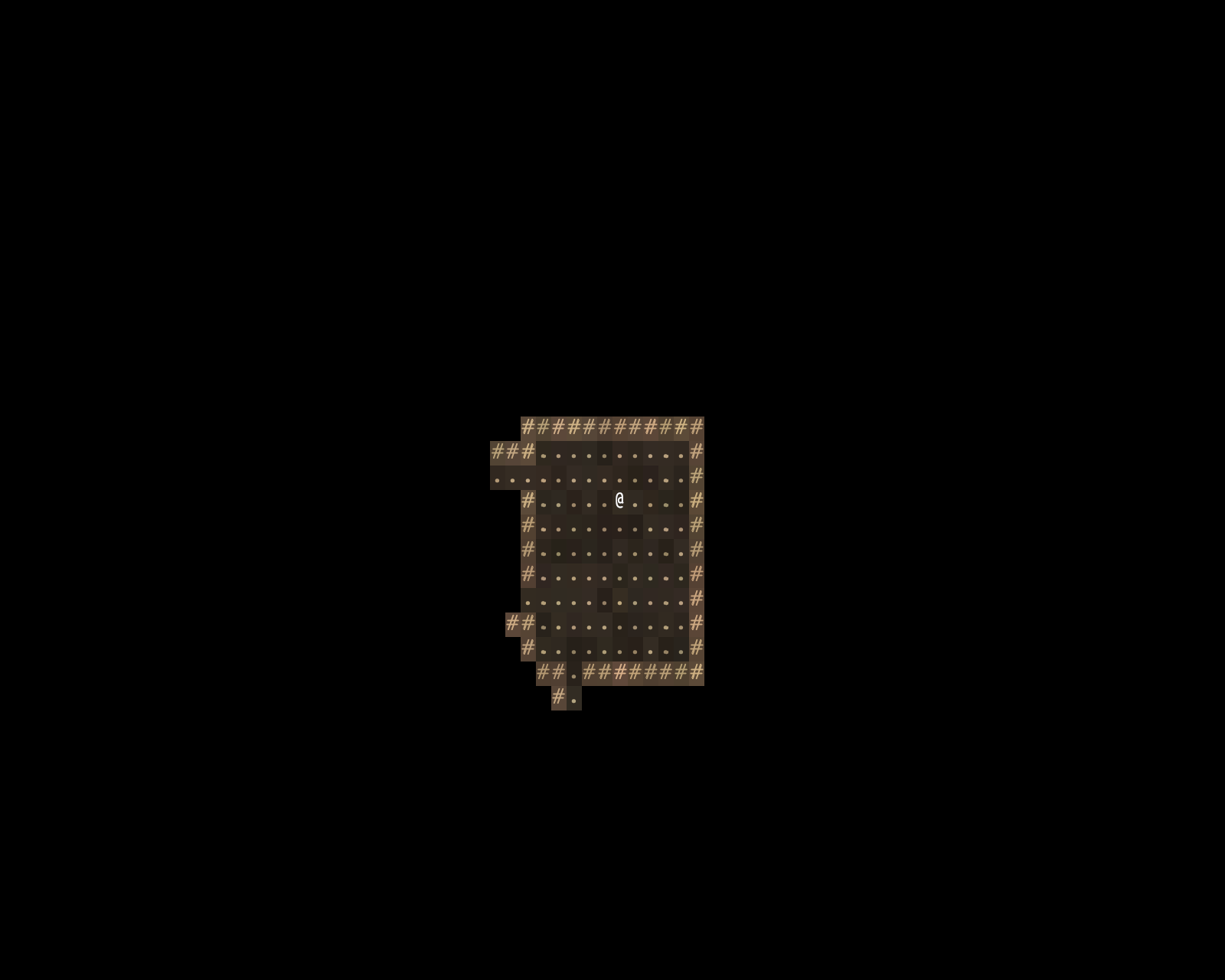
Loads about 8 MB
Generate a floor, hand it to the engine, draw it from the player’s point of view, and walk about on it.
The app
fn main() -> AppExit {
    let mut app = App::new();
    // What every game adds: the window and the glyph terminal, the turn
    // loop, sight, the map across the whole terminal, and the UI base.
    app.add_plugins(RoguelikePlugins::new("Warren", COLS, ROWS))
        .insert_resource(Seed(RunSeed(7)))
        .add_systems(NewRun, start)
        // Once a frame, before the turns: whatever the player pressed becomes
        // at most one intent, however many passes the turn loop then runs.
        .add_systems(Update, player_input.in_set(EngineSet::Input));
    app.run()
}
RoguelikePlugins is what every game adds, in one line.
It opens a window sized to an 80 by 40 cell glyph terminal and brings the plugins no game goes without: the glyph grid, the engine’s turn loop and map, field of view, the map view, particles, and the UI base.
Everything else is a plugin you name, starting in chapter 3, and nothing turns itself on because a resource happens to exist.
Leave out the WorldMap and play refuses to begin, listing everything missing at once with how to make each.
Seed is where all randomness comes from.
Every stream the engine draws on is derived from it, so the same number always builds the same warren.
NewRun is the schedule that starts a run, and the engine runs it again on a restart with the old run torn down first, which is why a game’s setup goes there instead of in Bevy’s Startup.
Tiles are ids
/// The warren's tiles, and how each one looks in full light.
struct Warren {
    tiles: TileRegistry,
    seed: RunSeed,
}

impl Warren {
    fn new(seed: RunSeed) -> Self {
        let mut tiles = TileRegistry::new();
        tiles.register(TileProps::wall("earth")).unwrap();
        tiles.register(TileProps::floor("dirt")).unwrap();
        Self { tiles, seed }
    }

    /// Both colours of every tile, and how much each cell jitters from
    /// its neighbours. The renderer derives darkness and memory from these.
    fn appearance(&self) -> TileAppearance {
        let mut look = TileAppearance::new();
        let t = |name| self.tiles.expect(name);
        look.set_varied(t("earth"), Cell::new('#', Color::srgb(0.78, 0.66, 0.50)).on(Color::srgb(0.34, 0.27, 0.21)), Vary::new(0.20, 0.05));
        look.set_varied(t("dirt"), Cell::new('.', Color::srgb(0.66, 0.58, 0.45)).on(Color::srgb(0.18, 0.15, 0.12)), Vary::new(0.28, 0.06));
        look
    }
}
register returns a dense TileId; expect looks one up by name and panics if it is missing.
All the engine knows about a tile is whether it is walkable and whether it blocks sight.
There is no Tile::Wall to extend, so lava, glass or a tile only ghosts can cross needs no engine change.
TileAppearance holds what each id looks like in full light.
Both colours are authored because light multiplies them channel by channel and memory fades them.
Vary jitters each cell’s colour by a hash of its position, so the floor is not graph paper.
The floor is a chain of passes
/// How a floor is built. The engine calls this once, the first time
/// something enters the map, and keeps what comes back.
impl PlaceRules for Warren {
    fn build(&self, _: MapId, _: Option<&WorldGraph>) -> Result<PlaceBuild, BuildError> {
        let (wall, floor) = (self.tiles.expect("earth"), self.tiles.expect("dirt"));
        let mut ctx = BaseContext::blank(84, 42, self.tiles.clone(), wall);
        Chain::new()
            .then(dungeon::Rooms { floor, attempts: 40, min_size: 5, max_size: 10, min_rooms: 6 })
            .then(dungeon::RandomStart)
            .run(&mut ctx, self.seed)?;
        PlaceBuild::from_context(ctx)
    }
}
PlaceRules::build is called once, the first time anything enters that map, and the result is kept for the run.
Rooms carves rectangles and joins them with corridors, and RandomStart picks a floor cell and reports it as the chain’s start point.
Each pass keys its own random stream off its name, so adding a pass later does not shift the numbers an earlier pass draws.
PlaceBuild::from_context reads the finished chain: the start point becomes the entry, an exit point becomes the exit if some pass emitted one, and prefab marks become spots to populate.
Handing it over
/// Hands the engine the map rules and the player, then warps the player in.
fn start(mut commands: Commands, seed: Res<Seed>, mut warps: MessageWriter<WarpRequest>, mut next: ResMut<NextState<EngineState>>) {
    let warren = Warren::new(seed.0);
    commands.insert_resource(warren.appearance());
    commands.insert_resource(WorldMap::new(warren.tiles.tables()));
    commands.insert_resource(PlaceRulesRes(Box::new(warren)));

    let player =
        commands.spawn(((Actor, Player, Blocks, Position(Point::ZERO)), (Viewshed::new(9), RevealsMap, Glyph::new('@', Color::WHITE).on_layer(10)))).id();
    warps.write(WarpRequest::into_place(player, WARREN));
    next.set(EngineState::Playing);
}
WorldMap::new takes the tile tables alone.
No world graph, no region size, no surface: a game with an overworld adds those, a delve never names them.
The player is components, not a class.
Actor takes turns, Player is the one the loop waits on for input, Blocks puts it in the occupancy index, RevealsMap marks whose sight fills in the explored map.
An intent, not a move
/// The player, but only while it is holding the turn.
type PlayerTurn<'w, 's> = Query<'w, 's, Entity, (With<Player>, With<MyTurn>)>;

/// Keys to intents. Writing an intent is the whole of asking to act: the
/// engine claims the turn, charges it, and refuses what cannot be done.
fn player_input(
    keys: Res<ButtonInput<KeyCode>>,
    dirs: Res<DirectionKeys>,
    repeats: Res<Repeats>,
    player: PlayerTurn,
    mut steps: MessageWriter<Intent<Step>>,
    mut waits: MessageWriter<Intent<Wait>>,
    mut exit: MessageWriter<AppExit>,
) {
    if keys.just_pressed(KeyCode::KeyQ) {
        exit.write(AppExit::Success);
        return;
    }
    // No turn in hand means it is somebody else's move; the key is dropped.
    let Ok(entity) = player.single() else { return };
    // A press walks, and a key held down keeps walking: `Repeats` is the
    // engine's hold, already advanced before input is read.
    if let Some(dir) = dirs.just_pressed(&keys).or_else(|| repeats.firing_any().map(|(d, _)| d)) {
        steps.write(Intent::new(entity, Step(dir)));
    } else if keys.just_pressed(KeyCode::Period) || keys.just_pressed(KeyCode::Numpad5) {
        waits.write(Intent::new(entity, Wait));
    }
}
Input never moves anybody.
It writes an Intent<Step> and stops.
The engine decides whether the actor may act, whether the move is legal, what it costs and what to do when it is not.
With<MyTurn> makes the query empty unless the player is holding a turn, so a key pressed while something else is moving is dropped.
DirectionKeys is the engine’s binding of the arrows, hjklyubn and the numpad to the eight directions, and just_pressed answers which one was struck.
It is a resource, so a game that wants other keys replaces it and writes no match statement of its own.
One pass of the turn loop
| Stage | What happens |
|---|---|
Schedule | The clock advances and one actor is dealt MyTurn |
Decide | Minds choose for everyone who is not the player |
Resolve | Intents become changes to the world |
Sweep | Anything nobody resolved is refused, with a warning naming it |
React | The game answers what the turn caused |
Cleanup | The actor is charged and requeued |
One actor holds a turn at a time and is out of the queue while it does.
Cleanup puts it back at now + cost.
Costs are hundredths of a normal step, and BASE_ACTION_COST is 100.
Speed(200) is twice as fast and the scheduler scales cost by it.
No floats in the clock, so a seed replays.
Walk into a wall and nothing happens: no time passes, and you keep the turn. A monster handed a free retry would spin forever, so a blocked monster is charged for a wait instead.
Try it
- Change
Viewshed::new(9)to4and watch the room close in. - Change the seed, then change it back and confirm you get the same floor.
- Give the player
Speed(200)and watch the turn counter climb half as fast.